

Practical Guide to Noise Insulation Experience of Countertop Blenders
May 20,2026
347
The loud noise emitted by countertop blenders is just like the roaring of a small electric drill, often putting users in a dilemma of wanting to keep a healthy diet while fearing disturbing others with noise. People are afraid of waking up family members when making breakfast in the early morning, worrying about affecting neighbors during daytime use, and it is totally impractical to run the blender at night. With the iteration of technologies, silent countertop blenders have come into being, and noise insulation effect has become a core standard for consumers to make purchases.
I. Noise Sources of Countertop Blenders
First of all, we need to figure out where the noise of blenders comes from. Blender noise is a compound noise formed by mechanical vibration and aerodynamic force, which is mainly divided into three categories. Noises from different sources vary greatly in frequency, intensity and propagation way, which also determines the core direction of noise insulation design.
(1) High-speed Operation of Motors
As the power core of a blender, the motor is also the biggest noise source. The motor speed of common countertop blenders is generally 25,000 to 40,000 revolutions per minute. During high-speed operation, electromagnetic vibration between rotors and stators, bearing friction and coil vibration will generate high-frequency noise of 600-3000Hz. This kind of noise is sharp and harsh, with long propagation distance and strong penetrability, accounting for more than 60% of the total noise of the machine.
Traditional brushed motors produce louder noise due to friction between carbon brushes and commutators, reaching 80-85dB(A). Brushless motors replace carbon brush friction with electronic commutation, which can reduce noise by 8-10dB(A), and this is also the core configuration of high-end silent models.
(2) High-speed Impact of Ingredients on Cup Wall with Strong Vibration Conduction
When the blender is working, the high-speed rotating cutter head drives ingredients to hit the cup wall, cup bottom and mixing ribs at a high speed, producing medium and low-frequency noise of 200-1500Hz. Though not as harsh as motor noise, it has large vibration amplitude. The vibration will be transmitted from the cup body to the base, and then spread to the tabletop and the ground to form structure-borne sound, making the whole kitchen filled with vibrating roar.
The harder and more the ingredients are, the more obvious the impact noise will be. Generally, the noise in dry bean mode is 5-8dB(A) higher than that in fruit and vegetable mode.
(3) Airflow Friction and Resonance: Auxiliary Noise that Aggravates Auditory Discomfort
The high-speed rotating cutter head stirs the air inside the cup and forms high-speed airflow friction noise. Meanwhile, if the vibration frequencies of the motor, cup body and base are close, it will trigger resonance effect and further increase noise intensity. In addition, poorly sealed cup lids and unstable placement of the machine will lead to noise leakage and intensified vibration, making the original noise even worse.
II. Core Noise Insulation Technologies of Countertop Blenders: Five Major Noise Reduction Solutions for Layered Interception from Source to Terminal
Aiming at the above noise sources, the noise insulation design of countertop blenders has formed a full-link system of "source noise reduction + physical barrier + vibration isolation". By superposing multiple technologies, mainstream models reduce the noise from the traditional over 80dB(A) to 45-60dB(A), and high-end flagship models can even control the noise below 40dB(A).
(1) Silent Motor Design: Reduce Noise Generation from the Root
Motor noise reduction is the core of silent blenders, and the key technologies include brushless variable frequency motor + precision bearing + shock-absorbing coil. The brushless motor runs steadily without carbon brush friction noise, and can intelligently adjust the rotating speed according to the hardness of ingredients to avoid continuous high-speed roaring. Precision silent bearings adopt low-friction materials to reduce operating vibration. Shock-absorbing coils wrap the motor stator to weaken the transmission of electromagnetic vibration. Actual test data shows that for models of the same brand and same power, brushless motors can reduce noise by 8-10dB(A) compared with brushed motors, which is the key to improving noise insulation effect.
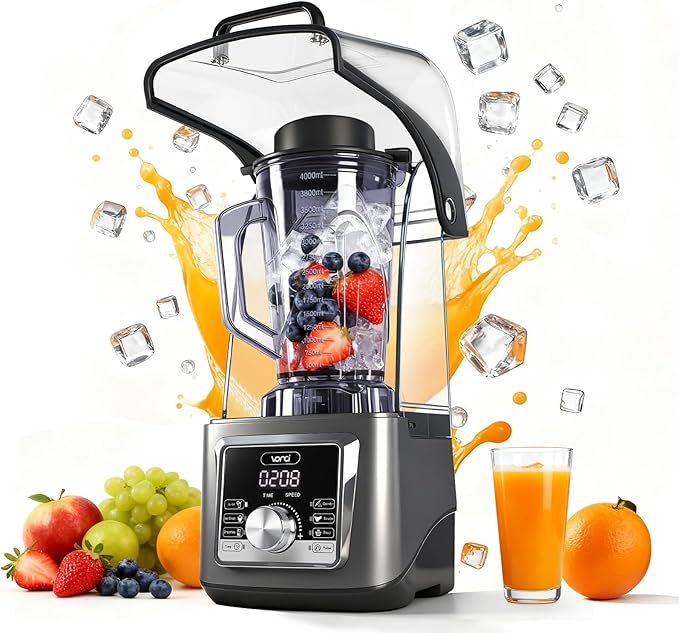
(2) Fully Wrapped Sound Insulation Cover: Physical Barrier to Block High-frequency Noise
The sound insulation cover is currently the most common and effective physical noise insulation solution, which is equivalent to putting sound insulation armor on the machine. High-quality sound insulation covers adopt a three-layer composite structure: the outer layer is made of high-strength ABS engineering plastic or tempered glass, which is firm and anti-vibration; the middle layer is filled with high-density sound-absorbing cotton (some high-end models adopt special sound-absorbing materials for recording studios) to absorb high-frequency sound waves by using porous structures; the inner layer is coated with smooth noise reduction coating to reduce noise reflection. Experimental data proves that installing a sound insulation cover can reduce noise by 3-5dB(A). More importantly, it can convert harsh high-frequency noise into low muffled sound, and improve auditory comfort by more than 50%. Some high-end models such as Midea Sleep Series are equipped with Helmholtz silencing system, which realizes air ventilation without sound transmission through expansion silencing valves to further reduce airflow noise.
(3) Double-layer Hollow Cup Body and Sealing Design: Weaken Ingredient Impact Noise
The cup body is the direct place where ingredient impact noise is generated. The double-layer hollow cup body blocks sound wave transmission through the air layer and also has anti-scald function, which is the basic configuration of 99% of blenders. On this basis, high-end models are upgraded with thickened high borosilicate glass with a thickness of 8-10mm, 30% thicker than ordinary cup bodies, which can effectively reduce medium and low-frequency noise caused by ingredient impact. The cup lid adopts silicone sealing ring + multi-buckle sealing design to prevent noise leakage from gaps and reduce airflow friction noise at the same time.
(4) Sunken Shock-absorbing Base and High-damping Foot Pads: Cut off Vibration Transmission
Vibration is an important way of noise transmission. The sunken base completely wraps the motor and cup base to form a closed shock absorption space and reduce the outward diffusion of motor vibration. The bottom of the base is equipped with high-damping composite material foot pads made of modified silicone-polyurethane blend with honeycomb microporous structure, whose dynamic loss factor is above 0.28. Their shock absorption effect is 70% better than that of ordinary rubber foot pads, which can effectively isolate the vibration transmission from the machine body to the tabletop and ground and prevent structure-borne sound from amplifying noise. Actual tests show that high-quality shock-absorbing bases can reduce the overall vibration acceleration by 32%, corresponding to a 3-5dB(A) drop in air noise.
(5) Optimized Air Duct and Resonance Suppression: Reduce Auxiliary Noise
High-end silent models optimize the internal air duct design of the cup and reduce airflow friction noise through flow guiding structures. Meanwhile, shock-absorbing silicone gaskets are installed at key parts of the machine body such as the connection between the motor and the base and the connection between the cup body and the base to avoid resonance caused by similar vibration frequencies of different parts and reduce noise amplification from details.
III. Actual Measured Data on Noise Insulation Effect of Countertop Blenders: Obvious Differences in Different Price Ranges and Modes
We cannot only rely on promotional descriptions to judge noise insulation effect, and actual measured decibel values plus auditory experience reflect the real use experience. Combined with industry standard GB 4706.1, laboratory data and user actual measurement, the noise insulation effect of countertop blenders can be divided into three tiers according to prices, and the noise varies obviously in different working modes.
(1) Industrial Noise Standards: Qualified Standard ≤78dB(A), Silent Standard ≤60dB(A)
According to the national noise standard for kitchen appliances, a blender is qualified if its no-load noise is ≤78dB(A) and load noise is ≤85dB(A). The industry-recognized standard for silent blenders is that the load noise is ≤60dB(A), which is equivalent to the volume of normal daily conversation and will not affect daily communication. Noise ≤50dB(A) is defined as ultra-silent, similar to the sound of soft speaking or page turning, and it will not disturb others when used in early morning or at night.
(2) Actual Measured Noise Insulation Effect of Models at Different Prices
1. Entry-level Models (Below 300 Yuan): Poor Noise Insulation, Noise 75-85dB(A)
Most entry-level models adopt brushed motor + single-layer thin cup body + simple rubber foot pads without special sound insulation covers, and only rely on the machine shell for simple noise reduction. The actual measured noise in dry bean mode is generally 78-85dB(A), as loud as vacuum cleaners or electric drills, with harsh high-frequency sound and strong vibration that can make the tabletop shake obviously. They have poor noise insulation effect and are not suitable for families sensitive to noise.
2. Mid-range Models (300-1000 Yuan): Mainstream Silent Type, Noise 55-65dB(A)
As mainstream products in the market, mid-range models are generally equipped with brushless motor + fully wrapped sound insulation cover + double-layer cup body + shock-absorbing base with multiple noise reduction technologies combined. Actual measured data are as follows:
Fruit and vegetable mode (low load): 50-55dB(A), equivalent to the volume of normal conversation;
Dry bean / rice paste mode (high load): 55-65dB(A), slightly louder than talking sound without harsh feeling;
At a distance of 2 meters, the noise drops below 50dB(A), and it will hardly affect other rooms with the kitchen door closed.
Representative models include Joyoung L15-P507 and Midea MJ-BL10SJ85, which adopt 9-layer or 12-layer noise reduction design, balancing noise insulation effect and cost performance.
3. High-end Models (Over 1000 Yuan): Ultra-silent Type, Noise 40-50dB(A)
On the basis of mid-range technologies, high-end flagship models are upgraded with vacuum sound insulation cavity + high-grade sound-absorbing materials + precision shock absorption structure, and some models have obtained national green noise certification. The stable noise in dry bean mode is 42-48dB(A), equal to the sound of soft speaking or ambient noise in libraries, and the no-load noise is as low as 38-42dB(A). It will not disturb others even if used at 6 a.m. in the early morning or 10 p.m. at night. Representative models include Midea FC12Pro and Blaupunkt Round Blender, equipped with BLDC brushless variable frequency motors and full-range noise reduction systems to achieve top-level noise insulation effect.
(3) Differences in Auditory Experience: Same Decibel Value with Totally Different Listening Feelings
Many users find that two blenders with the same decibel value bring different auditory feelings, one sounds low and mild while the other sounds sharp and unbearable. The core reason lies in different noise frequencies. Silent blenders reduce high-frequency noise and retain medium and low-frequency noise through optimized sound insulation covers and motors, bringing low and soft listening experience. Non-silent blenders have a high proportion of high-frequency noise with strong penetrability, leading to strong auditory discomfort.
IV. Key Factors Affecting Noise Insulation Effect of Countertop Blenders: Not Only Technologies, but also Usage and Maintenance Matter
Apart from the built-in noise reduction technologies of the blender itself, usage environment, operation methods and daily maintenance will also greatly affect the noise insulation effect. In most cases, loud noise is not caused by product quality problems but improper use.
(1) Placement Environment: Tabletop Material and Stability Affect Vibration Noise
Tabletop materials: wooden tabletops have good shock absorption effect and can absorb part of vibration; marble and glass tabletops are hard and smooth with strong vibration reflection, which will increase noise by 3-5dB(A);
Placement stability: incomplete fitting of machine foot pads with the tabletop or uneven tabletop will intensify machine vibration and trigger resonance, resulting in obvious noise increase;
Space size: narrow kitchens have strong noise reflection and sound more noisy, while open spaces allow noise to spread quickly with weaker noise perception.
(2) Ingredients and Capacity: Higher Load Brings Louder Noise
Ingredient hardness: the impact noise of hard ingredients such as dry beans and nuts is 5-8dB(A) higher than that of fruits, vegetables and rice paste;
Ingredient capacity: insufficient ingredients (less than 300ml) will make the cutter head idle and hit the cup wall to raise noise; excessive ingredients (exceeding the maximum capacity) will cause excessive motor load, intensified vibration and higher noise.
(3) Daily Maintenance: Sealing Condition and Component Status Determine Stable Noise Insulation Performance
Aging and deformation of cup lid sealing rings will lead to poor sealing and noise leakage from gaps, increasing noise by 5-10dB(A);
Worn and hardened shock-absorbing foot pads will lose shock absorption effect, making vibration transmit directly to the tabletop and aggravating noise;
Loose cutter heads and worn bearings will cause abnormal vibration and extra noise during operation, which needs timely inspection and repair.
V. How to Choose Blenders with Good Noise Insulation and Optimize Noise Reduction Effect
(1) Purchasing Guide: 5 Core Dimensions to Avoid Fake Silent Products
Prioritize brushless motors: Choose blenders equipped with BLDC brushless variable frequency motors, which are 8-10dB(A) quieter than brushed motors and more stable in long-term use;
Pay attention to sound insulation cover configuration: Select fully wrapped three-layer sound insulation covers with outer tempered glass or ABS material and middle high-density sound-absorbing cotton, and stay away from semi-enclosed and decorative sound insulation covers;
Focus on shock absorption design: Confirm the configuration of sunken bases and high-damping silicone foot pads with thickness no less than 5mm, and honeycomb structure is better to effectively cut off vibration transmission;
Check actual measured noise data: Focus on the actual measured noise 1 meter away in dry bean mode. Qualified mid-range models shall be ≤65dB(A) and high-end models ≤50dB(A). Be alert to products only marked with no-load noise;
Refer to authoritative certifications: Give priority to models with national green noise certification for reliable noise insulation performance.
(2) Usage Skills: 3 Methods to Maximize Noise Insulation Effect
Place stably: Choose wooden tabletops and ensure foot pads fit closely without shaking. You can lay a non-slip shock absorption mat on the tabletop to further reduce vibration;
Control ingredient capacity reasonably: Keep ingredients within 50%-80% of the maximum capacity to avoid idling due to insufficient ingredients or overload caused by excessive ingredients. Soak hard ingredients in advance to lower impact noise;
Carry out regular maintenance: Regularly check cup lid sealing rings and shock-absorbing foot pads and replace them in time once aging. Keep cutter heads and bearings clean to avoid abnormal noise caused by wear.
Choose Suitable Blenders According to Actual Demand for Noise Insulation
In conclusion, the noise insulation effect is mainly determined by three major factors: motor type, sound insulation cover design and shock absorption structure. Mid-range blenders priced from 300 to 1000 Yuan can meet the daily silent use needs of most families, while high-end models are suitable for families extremely sensitive to noise who need to use blenders in early morning or late night.
It needs to be emphasized that silence does not mean zero noise. Due to the high rotating speed feature, blenders cannot achieve complete zero noise. However, through reasonable selection and standard use, we can fully control the noise within a range that will not affect daily life and disturb neighbors, and enjoy both healthy diet and quiet life.